
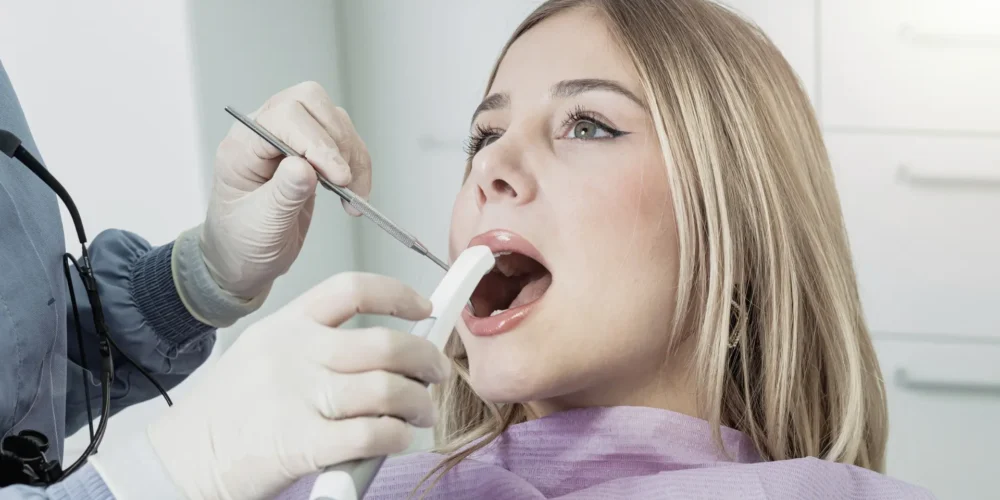
Dentistry has come a long way from traditional impressions. Today, digital technology allows us to capture highly detailed images of the teeth and mouth, helping our clinicians plan and deliver treatment with an exceptional level of precision.
At The Kensington Dentist, intraoral scanning is an important part of our approach to modern dentistry. From routine examinations through to restorative and orthodontic treatment, digital scans allow us to create an accurate 3D representation of your teeth and use this information throughout your treatment journey.
What is intraoral scanning?
An intraoral scanner is a small, handheld digital device that is gently moved around the mouth to capture thousands of images of the teeth and surrounding structures.
These images are combined to create a highly detailed 3D digital model of your mouth. Unlike traditional impressions, there is no need for impression material or trays, making the process quick, comfortable and highly precise.
The resulting digital model can then be used by our clinicians to assess your teeth, plan treatment and create bespoke dental appliances and restorations.
How do we use intraoral scanning at The Kensington Dentist?
Intraoral scanning has applications across many areas of dentistry and is now an integral part of how we examine, plan and monitor treatment.
Examinations and treatment planning
Intraoral scans can form part of your dental examination, giving our clinicians a detailed digital record of your teeth.
The scans can also be revisited over time, allowing us to monitor changes and compare your teeth at different stages of your dental care. This can be particularly useful when planning more complex or long-term treatment.
Restorative dentistry
Digital impressions are particularly valuable when creating restorations that need to fit seamlessly with your existing teeth.
We use intraoral scanning when planning and creating treatments such as:
- Crowns
- Inlays
- Implant crowns
- Nightguards
The detailed digital information captured by the intraoral scanning technology allows restorations and appliances to be designed with accuracy and tailored specifically to your mouth.
Orthodontics
Digital scanning has also transformed the way we plan and monitor orthodontic treatment.
At The Kensington Dentist, our scans can be used to create expansion plates and retainers, as well as to monitor progress during Invisalign treatment.
For Invisalign, digital scans allow our Orthodontic team to track how your teeth are moving throughout treatment and assess your progress against the planned outcome.
For expansion plates and retainers, the digital model allows appliances to be designed specifically around the shape and position of your teeth, helping to achieve a precise and comfortable fit.
Why choose digital intraoral scanning?
One of the greatest advantages of intraoral scanning is the combination of comfort and precision.
Traditional impressions can feel bulky and uncomfortable for some patients. Digital scanning removes the need for impression material while allowing our clinicians to capture incredibly detailed information.
It also makes the treatment process more streamlined. Digital files can be stored securely and shared directly with dental laboratories and treatment providers when required, reducing the need for physical impressions and making communication between the clinical team and laboratory more efficient.
Most importantly, it gives our clinicians another level of detail when planning your care.
Precision at every stage of your treatment
At The Kensington Dentist, technology is not about replacing clinical expertise, it is about enhancing it.
Intraoral scanning technology gives our clinicians a clearer, more detailed understanding of your teeth and allows us to combine this information with our clinical assessment, experience and treatment planning.
Whether you are attending for a routine examination, considering restorative treatment or undergoing orthodontic care, digital scanning is one of the many ways we use modern technology to provide a more precise and considered experience.
Because when it comes to your smile, the finer details matter.